
The question I used to dread
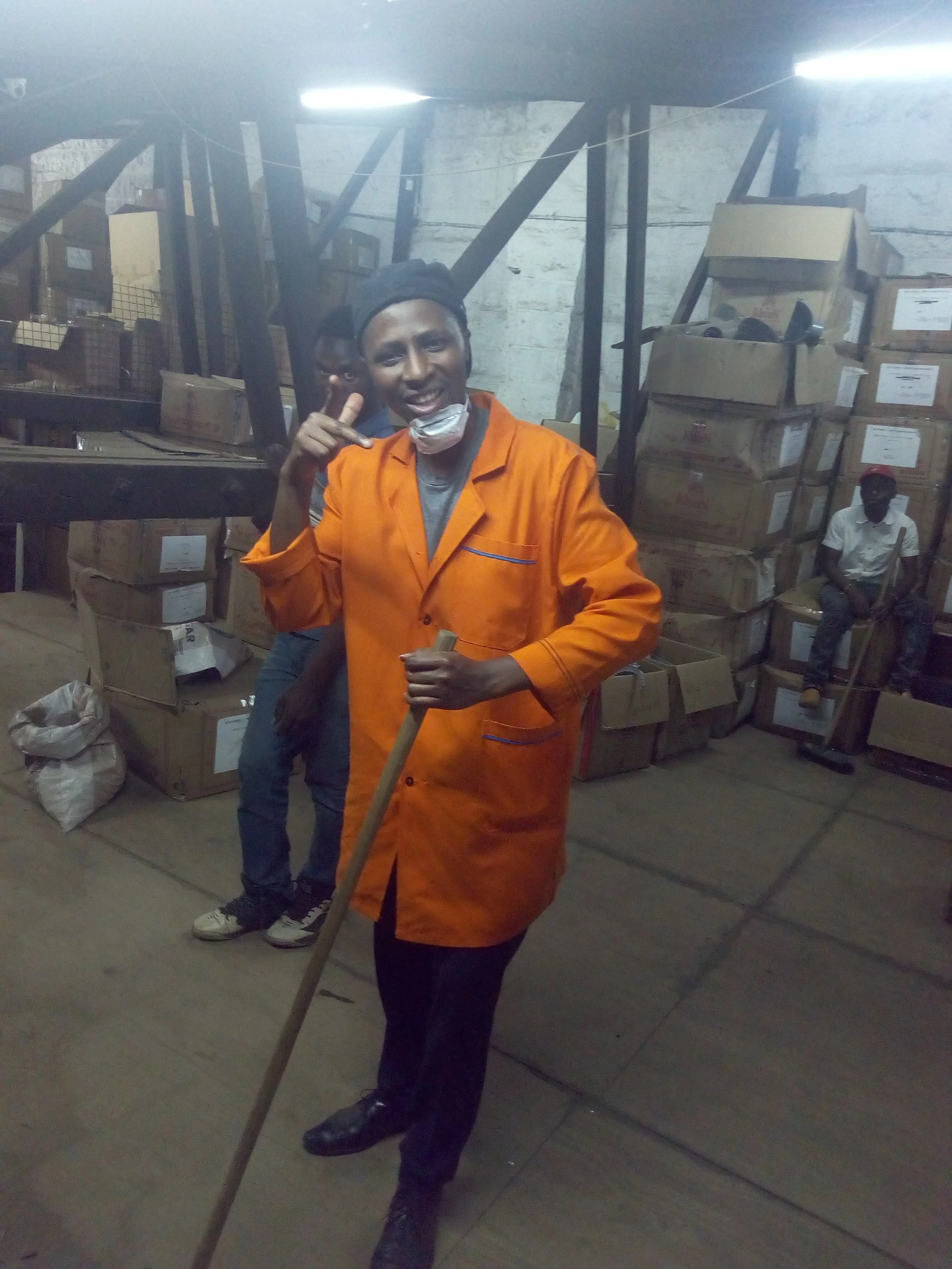
I want to tell you about one Monday in the afternoon of November 2019. I was in a warehouse in Nairobi's Industrial Area, broom in hand, and with a mask pulled down under my chin because the dust in that building got into your throat, your eyes, and the creases of your hands. One of my workmates took this photo. As you can see, I'm grinning, pointing at the camera, because that is what you do when someone points a camera at you and you are twenty-something and the day is long.
I was good at my job, which was almost everything in that warehouse really. One hour you are cutting gutters, the next you are sweeping the concrete floor, and the next you are throwing your weight into loading a truck.
And although I was good at it, I couldn’t bring myself to say it. I didn’t have the words, or maybe I didn't have the courage, to own the dignity of that sweat.
Because three days later, things would change completely. I would be at an event in the city, very well dressed, talking to someone I admired or just wanted to interact with. And they would lean in, the way people do when they think you're interesting — and ask me what I did.
“I'm currently volunteering with a community-based organisation in Kibera,” I would say, which was true.
I did volunteer. I just left out the broom and the gutters.
I did this for a long time and got fluent at it. I could steer a conversation around the shape of my own life so smoothly that nobody noticed the swerve, and I would walk home afterwards feeling like I had got away with something and sick about it at the same time.
I knew if I said I clean a warehouse, the conversation would end. It would just thin out, politely. Their eyes would go over my shoulder to find the next interesting person in the room, and the warmth would drain out of the exchange so gradually that neither of us would have to acknowledge it had happened. It’s something I had observed. I had watched it happen to other people.
So I lied by omission, in a suit, to people I admired, about honest work I was doing to keep myself alive.
If you have done some version of this, I'm not going to tell you that you shouldn't have. You were reading the room correctly.
But I want to say something that took me years to understand, because nobody said it to me and I needed someone to.
It is one thing to know, intellectually, that what you do is not what you are worth. You can agree with that sentence completely. You can say it to a friend who's struggling and mean every word. And then someone asks you the question at a party and you say something that leaves out the broom, and you discover that knowing a thing and embodying it are separated by a distance you cannot cross simply by choosing to do so.
I don’t think that distance is a failure of willpower. It's what happens when a belief lives in your head and the shame lives in your body. They are not in the same room. Arguing with yourself doesn't move it. What moves it is time, and being around people whose mood doesn’t change when you show them the dirt under your fingernails, and one day noticing that you answered the question honestly and the sky didn't fall.
I'm on the other side of it now. I can tell you what I did in 2019 without my chest tightening, which is a massive step, and something I could not have done in 2020.
So if you're in it, if you have lost work, or if you have work that the world has quietly decided isn't worth asking a follow-up question about — I'm not going to give you a new mantra or an alternative way to respond. You've heard a lot of those and they don't reach the part of you that flinches.
What I'll say instead is this: you are not behind. The distance between knowing and embodying is normal, and it closes slowly, and nobody who tells you otherwise has walked it.
The broom was honest. It always was. It just took me a while to say so out loud.