
Mental Wellness After Job Loss: The Action Plan That Actually Works
Three weeks out. You’ve done what you were supposed to do. Updated LinkedIn, reached out to a few old contacts, and joined a job search group. You move because movement feels like control.
Anxiety lingers. Mornings feel off. You ping-pong between "I need to fix this" and "I can't face this," sometimes within minutes. You feel behind, though you can’t say what being ahead signifies.
Here’s what most people don’t hear early enough: the action plan everyone defaults to, which includes job boards, resume tweaks, and networking coffees tends to skip a critical step. Mental wellness after job loss isn’t a sidebar to the job search. It’s the ground the search runs on. Skip it, and you get motion but little traction.
The “Stay Busy” Trap
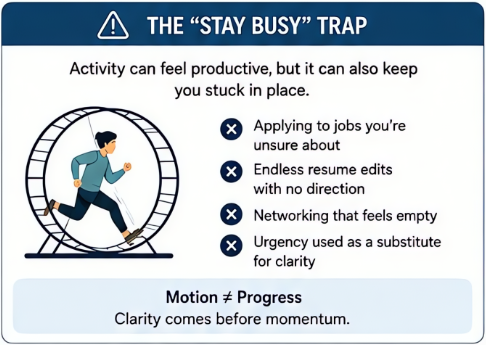
Staying busy after a layoff feels like progress. Sometimes it is. But most people use activity to sidestep processing and treat urgency as a substitute for clarity.
They send applications for roles they’re unsure about. They rewrite their resume for a direction they haven’t chosen. They attend networking events that feel hollow and wonder why nothing lands.
This isn’t laziness in reverse. It’s premature, like building on ground that hasn’t settled.
The cultural pressure is real. We don’t give people permission to slow down after a job loss. We give them advice: update your skills and treat the search like a full-time job. None of it is wrong, but the timing is off.
Emotional recovery after a layoff doesn’t happen in the background while you stay busy. It needs attention. Until then, practical work seems empty, wrong, or exhausting.
What’s Actually Happening

Job loss triggers a grief response. Not a metaphor. That’s what the research shows, and what most people in the middle of it can feel, even if they’d resist the word grief.
You didn’t just lose a paycheck. You lost a structure that told you when to get up, where to be, and what your output meant. Possibly years of professional ties and an aspect of yourself you’d been building for a long time.
Some people face this directly. Others go straight into fix-it mode, and the grief catches up later, usually at the worst moments and harder than it would have been.
The question isn’t whether you’ll deal with the emotional load of what happened. You will. The only question is whether you do it intentionally or let it do it to you.
The Mental Wellness Action Plan: Start Inside
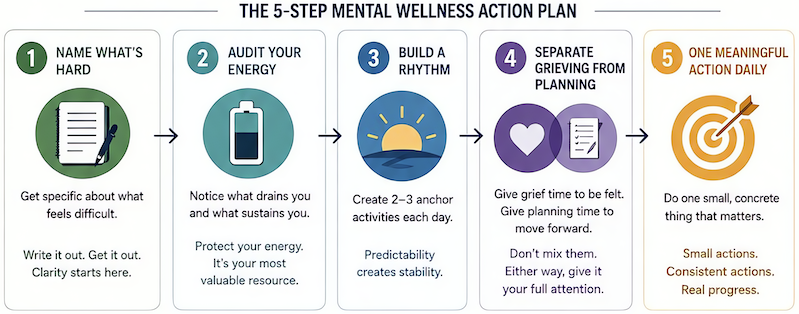
This is a framework, not a formula. You don’t need to have anything figured out to use it. You just need to do the right things in the right order. That order starts inside before it moves outward.
Step 1: Name What Happened Before You Start Solving It
Not just I lost my job. That’s true, but thin. What specifically feels hard?
Take 20 minutes to write out specifically what feels difficult. Is it financial uncertainty, loss of daily structure, a blow to your career identity, or shame—even when the layoff wasn’t personal? Identify each challenge clearly. This helps turn vague anxiety into specific, manageable fears. Don’t try to solve them yet—just label them as your starting point.
Step 2: Audit Your Energy, Not Just Your Skills
Most job loss advice tells you to audit your skills. That’s useful eventually. Right now, the most important audit is your energy.
What’s draining you? What’s sustaining you, even slightly? Three hours of job board scrolling or another cover letter rewrite at midnight can feel like progress, but often depletes you. A long walk or a real conversation with someone who knows you well can feel like avoidance, but it is essential. Be honest about the difference. Your energy is finite, and where it goes matters.
Step 3: Build a Rhythm, Not a Schedule
Establish a simple daily rhythm by choosing 2-3 consistent anchor activities, such as a morning walk, a scheduled job-search block, or a set phone-down time. Do these at roughly the same time each day, focusing not on productivity but on predictable structure. Predictability, not packed schedules, provides stability during uncertainty.
A morning walk. A set time to put your phone down. A job search block with a clear start and end. The goal isn’t to fill every hour but to give yourself enough consistency to function. That consistency comes from your energy, not grinding.
Step 4: Separate Grieving Time From Building Time
When grief and planning occur simultaneously, they interfere with each other. Grief makes planning feel hopeless, and planning makes grief feel indulgent. Neither gets what it needs.
Schedule a weekly hour to process feelings about job loss, using a journal, therapist, or friend. During this time, focus only on emotional recovery—do not solve or plan. Then set aside time for forward-facing job-search tasks, such as sending applications or exploring new directions. Give each part your full attention by keeping these sessions separate.
Step 5: Define One Meaningful Action per Day
Choose a single, concrete action that helps you progress or maintain your well-being. Examples: reach out to one contact, revise a part of your resume, or register for a course. Focus on completing this one action rather than juggling several tasks at once.
One meaningful action per day is enough. A thoughtful message to someone you want to reconnect with, revising a section of your resume, or registering for a course that interests you all count.
Make it doable. Make it count. Small, consistent actions compound. You don’t need to sprint back. You just need to keep moving.
A Word on Timeline
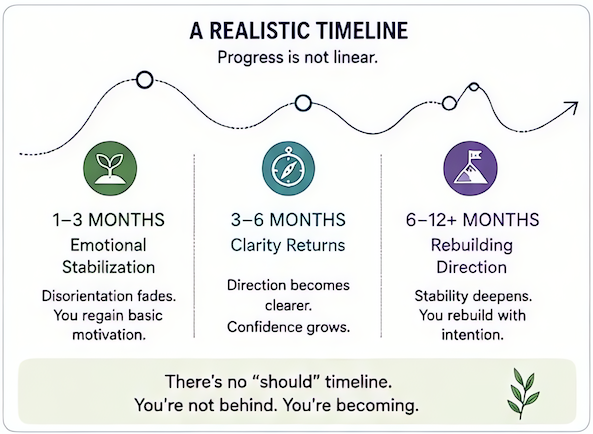
There is no “further along than you should be.” There’s only where you are.
Four weeks in and still struggling to find your footing? That’s not a sign that something is wrong with you. It’s a sign that what you went through was significant. Job loss, even when it leads somewhere better and even when you saw it coming, disrupts your entire sense of stability. It takes time to rebuild, and the timeline isn’t linear.
Everyone recovers at a different pace, but some patterns are common. In the first days or weeks, you may feel disoriented or numb. For many, it takes one to three months to emotionally settle and regain basic motivation. Clarity about work direction or confidence in following steps often gradually returns between three and six months. For some, it can take closer to a year or longer to fully rebuild stability and direction. It’s normal for progress to come in waves. If you’re struggling at the four, eight, or twelve-week mark, you are right on track. Allow your own pace and recognize that slow progress is still progress.
The people who recover most effectively aren’t the ones who pushed through fastest. They’re the ones who built the right foundation before they started sprinting.
Start Here, Today
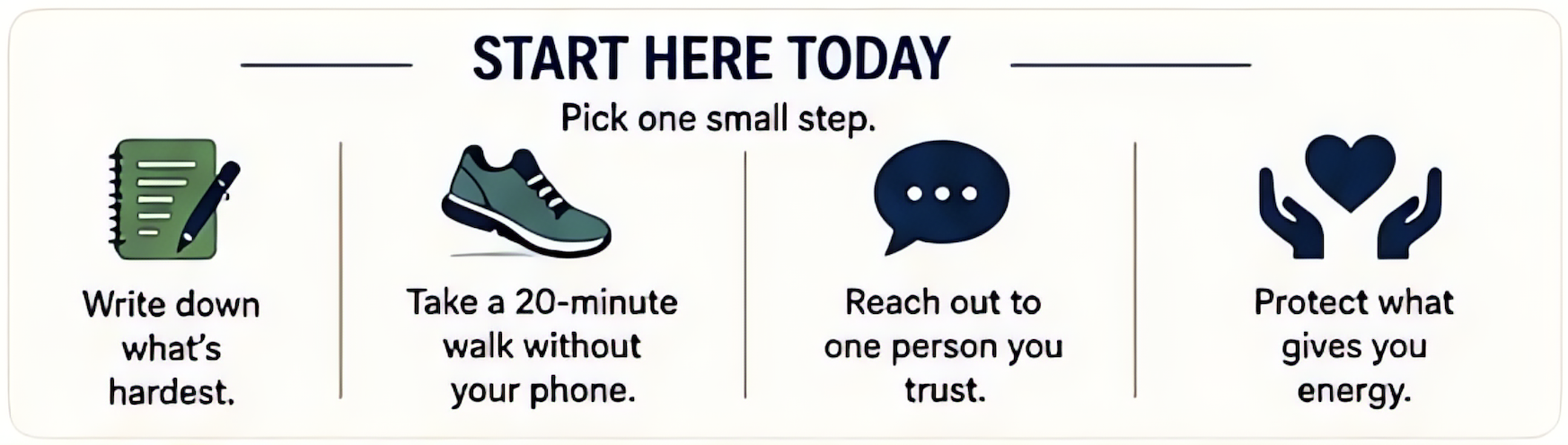
You don’t need a complete plan. You need a place to start.
Pick one actionable step from this system and do it today. For example, write down what’s hardest for you right now. Take a 20-minute walk without your phone. List what sustains you and decide how to protect those things. Other specific actions: join a support group, choose a time to check in with a friend each day, write down three things you accomplished this week, or spend five minutes practicing mindful breathing. Any simple action starts your recovery—just choose one and act on it.
Rebuilding is possible without having everything figured out. It just requires starting with the right thing, in the right order, and that order begins with you.
Unbroken Pathways offers organized support and guided recovery tools for people navigating job loss and career transitions. Explore our programs like Restore Your Well Being and our tools like the Emotion check-ins, Name It videos and Reset videos.
Frequently Asked Questions
Q: What is structured recovery after career disruption?
A: Structured recovery is a deliberate, step-by-step process for rebuilding your professional life after a major setback, whether that’s a layoff, burnout, or a career change you didn’t choose. It’s different from generic “get back out there” advice because it starts by accepting that career disruption is disorienting, not just inconvenient. The process moves through clear phases: stabilizing, reflecting, planning, and re-engaging, in that order. Most people who spin their wheels for months skip one of those phases. That’s what the sequence is for.
Q: How do I know if I’m stuck or just recovering?
A: Recovery takes time. Being stuck is different. If weeks have passed and you’re avoiding applications, replaying what went wrong, or struggling to picture any version of your future, that’s stuck, not resting. The clearest signal is inaction that feels involuntary. You want to move but can’t. Structured recovery exists exactly for that gap: when rest has run its course, but forward motion isn’t happening on its own.
Q: What does structured career recovery actually look like, step by step?
A: Most effective structured recovery follows a rough sequence. First, you stabilize. Handle the urgent financial and emotional fallout so panic doesn’t drive your decisions. Then you reflect. Get honest about what you actually want, not just what you had before. Then you plan. Identify realistic following steps, skills to build, and people to reconnect with. Finally, you re-engage. Take consistent small actions that build real momentum over time. Jumping straight to re-engagement without the earlier phases is why many people cycle through disruption repeatedly without real resolution.
Q: How long does career recovery take?
A: It depends on the depth of the disruption, not just how long you’ve been unemployed. Someone who was laid off after three years recovers differently from someone who spent 12 years in a role that no longer exists. Most people underestimate how long genuine recovery takes, not finding another job, but actually feeling stable and directed again. That often takes six months to a year, sometimes longer. The goal of structured recovery isn’t to rush that. It’s to make sure the time is used well.
Q: Can I recover without knowing what I want next?
A: Yes, and that’s actually the more honest starting point for most people. Waiting for perfect certainty before taking action is a trap. Structured recovery doesn’t require a finished plan. It requires movement with enough intention to learn from. You don’t figure out what you want by thinking about it indefinitely. You figure it out by trying things, reflecting, and adjusting. Clarity comes through action, not before it.
Q: What’s the difference between job searching and career recovery?
A: Job searching is tactical. Applications, CV updates, interview prep. Career recovery goes deeper. It’s understanding what happened, deciding what you actually want, and building the foundation to get there. You can job search without recovering. Many people do. They land quickly and find themselves in the same situation two years later. Most people treat disruption as something to get past. Structured recovery treats it as something to understand. That shift is what makes the difference.
Q: Why do some people stay stuck for months or years?
A: Most often, they started job searching before stabilizing emotionally, they chased the same role they lost instead of reassessing what they actually want, or they isolated instead of building support. Career disruption carries a social stigma that makes people want to fix it quietly and fast, and that urgency usually backfires. Another factor is confusing busyness with progress. Updating LinkedIn and applying in bursts feels like momentum. Often it isn’t. Structured recovery provides the sequence and accountability that self-directed effort frequently lacks.
Q: Is career recovery the same as career change?
A: They overlap, but they’re not the same. Career recovery is about rebuilding stability and direction after disruption. It may or may not lead to a different field. Career change is about deliberately moving into something new, sometimes from a place of strength rather than crisis. Structured recovery can include a career change, but it starts with the disruption itself, not the destination. Treating them as identical causes people to rush the decision-making phase before they’ve had time to stabilize.
Q: What does “getting unstuck” actually mean?
A: It means moving from paralysis or repetitive inaction to consistent, directed progress. Not that everything suddenly feels good, just that it no longer feels impossible to move. In practice: making one meaningful contact per week, committing to a course or skill-building activity, and keeping a weekly planning routine. Unstuck isn’t a feeling. It’s a behavior.
Q: Where do I start if I have no idea how to begin?
A: Start with the smallest possible honest action, not the most impressive one. Write down what happened, just for yourself. Have one real conversation with someone you trust. Spend an hour mapping your actual financial runway. The first step in structured recovery isn’t a strategy. Its orientation. Understanding where you actually are before deciding where you’re going. That’s exactly what Unbroken Pathways was built for: people who don’t know where to begin, not people who already have a plan.
